IJSRET » September 16, 2025

Daily Archives: September 16, 2025

Uncategorized

The Open-Source Journey From Oracle Enterprise Linux To A Red Hat Powered Hybrid Cloud

Authors: Kabir Das

Abstract: The evolving demands of enterprise IT are driving organizations to modernize legacy infrastructures while leveraging the flexibility and scalability of hybrid cloud platforms. Oracle Enterprise Linux (OEL), traditionally a reliable foundation for enterprise workloads, faces challenges in cost, cloud readiness, and integration with modern open-source tools. This review explores the strategic migration from OEL to Red Hat Enterprise Linux (RHEL), emphasizing hybrid cloud deployment as a pathway to operational efficiency, scalability, and future-ready IT environments. The article examines comparative aspects of OEL and RHEL, including architecture, system features, package management, and enterprise support considerations. A structured migration framework is presented, encompassing workload assessment, risk analysis, phased adoption, and containerization strategies to ensure minimal disruption and consistent performance. Hybrid cloud architectures leveraging RHEL enable enterprises to retain critical workloads on-premises while utilizing cloud resources for elasticity, analytics, and AI-driven insights. Containerization and microservices architectures, orchestrated via Kubernetes and Red Hat OpenShift, facilitate portability, modularity, and high availability across heterogeneous infrastructures. Automation and DevOps practices, including Infrastructure as Code (IaC), CI/CD pipelines, and predictive monitoring, streamline deployments, enhance operational consistency, and reduce human error. Security and compliance frameworks, encompassing identity and access management, encryption, auditing, and adherence to regulatory standards, safeguard critical data throughout the hybrid environment. Case studies from financial and telecommunications sectors illustrate practical insights, benefits, and lessons learned during real-world migrations. Emerging trends, including AI-driven analytics, serverless computing, and edge processing, are analyzed for their impact on hybrid cloud operations. By synthesizing technical guidance, strategic recommendations, and industry best practices, this review provides a comprehensive roadmap for enterprises transitioning from OEL to RHEL-powered hybrid cloud infrastructures, enabling agility, resilience, and sustainable competitive advantage in modern IT landscapes.

DOI: https://doi.org/10.5281/zenodo.17141616


Published by:
Uncategorized

Securing The Hybrid Perimeter A Deep Dive Into LDAP/AD And Cloud-Native Security

Authors: Sunil Gupta

Abstract: As enterprises increasingly adopt hybrid IT infrastructures, combining on-premises systems with cloud-native platforms, securing the hybrid perimeter has become a critical priority. Centralized identity and access management solutions, such as LDAP (Lightweight Directory Access Protocol) and Active Directory (AD), provide foundational frameworks for authentication, authorization, and policy enforcement across heterogeneous environments. This review explores the integration of traditional directory services with cloud-native security mechanisms, emphasizing identity federation, multi-factor authentication, and automated policy enforcement. The article examines architectural considerations for LDAP and AD, including hierarchical structures, replication strategies, and schema design, while highlighting protocols such as Kerberos, SAML, OAuth, and OpenID Connect for secure, federated authentication. Access management models, including Role-Based Access Control (RBAC) and Attribute-Based Access Control (ABAC), are analyzed within hybrid environments to demonstrate effective policy enforcement, conditional access, and Zero Trust security principles. Hybrid cloud deployments present unique challenges in maintaining consistent security policies, regulatory compliance, and monitoring across diverse platforms. Centralized logging, Security Information and Event Management (SIEM), and AI-driven analytics enhance threat detection, anomaly monitoring, and proactive incident response. Real-world case studies from financial services and healthcare illustrate best practices for integrating LDAP/AD with cloud-native security, demonstrating operational efficiency, compliance adherence, and risk reduction. Emerging trends, including passwordless authentication, AI-assisted security operations, and cloud identity federation, provide additional layers of resilience and adaptability. By synthesizing technical guidance, best practices, and strategic recommendations, this review offers a comprehensive framework for securing hybrid enterprise environments. Organizations adopting these practices can achieve robust perimeter security, operational efficiency, and scalable, future-ready infrastructure.

DOI: http://doi.org/

Published by:
Uncategorized

The Websphere Modernization A Practical Guide To Migrating To Open-Source Jboss

Authors: Payal Verma

Abstract: Enterprise IT landscapes are increasingly seeking modernization pathways to reduce costs, enhance flexibility, and adopt cloud-native architectures. IBM WebSphere, long a cornerstone of enterprise middleware, presents challenges related to licensing costs, vendor lock-in, and scalability limitations. Red Hat JBoss (WildFly), as an open-source alternative, offers modular architecture, community-driven support, and adaptability for modern DevOps and containerized deployments. This review article provides a comprehensive guide for migrating from WebSphere to JBoss, covering architectural comparisons, migration planning, technical execution, integration strategies, testing methodologies, and post-migration operational considerations. Practical insights are drawn from case studies and lessons learned, emphasizing best practices in risk mitigation, automated deployment, security compliance, and performance optimization. By systematically analyzing the migration process, the article equips IT architects, system administrators, and enterprise decision-makers with actionable strategies to achieve a seamless transition while maintaining operational continuity, performance reliability, and long-term scalability.

DOI: http://doi.org/

Published by:
Uncategorized

The Business Of IT How Kickstart Methodologies Drive Value In Hybrid Cloud Projects

Authors: Nisha Kumar

Abstract: Hybrid cloud adoption has become a critical strategy for enterprises seeking scalability, flexibility, and operational efficiency. However, the complexity of managing heterogeneous on-premises and cloud infrastructures often leads to deployment delays, resource inefficiencies, and increased operational risk. Kickstart methodologies provide a structured framework for automation, standardization, and repeatable deployment processes, enabling organizations to streamline hybrid cloud projects while ensuring consistency, reliability, and governance. This review explores the technical and business implications of applying Kickstart in hybrid cloud environments, highlighting benefits such as cost efficiency, accelerated time-to-market, risk mitigation, and improved operational agility. Real-world case studies illustrate practical applications, lessons learned, and best practices for leveraging Kickstart to optimize deployment pipelines, integrate DevOps workflows, and enhance IT value. By combining automation with strategic operational planning, Kickstart methodologies empower enterprises to achieve measurable business outcomes and future-proof their hybrid cloud initiatives.

DOI: http://doi.org/

Published by:
Uncategorized

The UNIX Revival Why Solaris And AIX Still Matter In Todays Hybrid Cloud Landscape

Authors: Kiran Pandey

Abstract: Despite the rise of modern operating systems and cloud-native platforms, Solaris and AIX continue to play a critical role in enterprise IT infrastructure. These UNIX systems are renowned for their reliability, security, high availability, and performance, making them indispensable for mission-critical workloads in finance, healthcare, government, and other sectors. As enterprises adopt hybrid cloud strategies, integrating legacy UNIX workloads presents both challenges and opportunities. This review explores the technical strengths of Solaris and AIX, including virtualization, clustering, and resource management, as well as strategies for hybrid cloud integration, migration, and coexistence. Case studies illustrate real-world applications, lessons learned, and best practices for maintaining operational continuity while leveraging cloud scalability and modern services. The article concludes by assessing emerging trends, such as containerization, multi-cloud adoption, and AI-driven automation, demonstrating that Solaris and AIX remain strategic assets for hybrid cloud environments.

Published by:
Uncategorized

Beyond The Sales Funnel Salesforce Automation And The Future Of Hybrid Infrastructure

Authors: Rohan Chopra

Abstract: Salesforce automation has become a critical component of enterprise CRM strategies, particularly within hybrid infrastructure environments that combine on-premises systems with cloud resources. By automating workflows, approvals, and data management, organizations can improve operational efficiency, reduce errors, and enhance customer engagement. This review examines the technical and business aspects of Salesforce automation, including integration strategies, middleware, CI/CD pipelines, and monitoring frameworks. Real-world case studies from financial services, healthcare, and government highlight lessons learned, best practices, and measurable benefits of automation in hybrid contexts. The article also explores emerging trends, including AI-driven predictive workflows, multi-cloud deployments, and edge computing, demonstrating how these innovations extend the value of Salesforce automation while ensuring scalability, compliance, and operational resilience.

DOI: https://doi.org/10.5281/zenodo.17132340


Published by:
Uncategorized

Identity As The New Perimeter LDAP/AD Best Practices For A Hybrid IT Environment

Authors: Harshita Verma

Abstract: As enterprises adopt hybrid IT environments, traditional network perimeter defenses are no longer sufficient to protect critical resources. Identity has emerged as the new perimeter, with LDAP and Active Directory (AD) serving as foundational technologies for managing authentication, authorization, and access control across distributed systems. This review examines best practices for LDAP and AD management, including role-based access control, multi-factor authentication, automated provisioning and deprovisioning, monitoring, and incident response. It also explores integration strategies with cloud platforms, Single Sign-On (SSO), and DevOps workflows, highlighting real-world implementations and lessons learned from finance, healthcare, and government sectors. Finally, the article addresses emerging trends such as Zero Trust architecture, AI-driven behavioral analytics, and multi-cloud orchestration, emphasizing the evolving role of identity in securing hybrid IT infrastructures and ensuring compliance, operational efficiency, and resilience.

DOI: https://doi.org/10.5281/zenodo.17132184


Published by:
Uncategorized

Kickstarting Your CRM A Strategic Guide To Integrating Salesforce With Legacy Systems

Authors: Sai Dubey

Abstract: Enterprises increasingly rely on hybrid IT environments that combine modern CRM platforms, such as Salesforce, with legacy systems like ERP, mainframes, and on-premises databases. Integrating these disparate systems is essential for operational efficiency, data consistency, and enhanced customer engagement. This review examines best practices for Salesforce-legacy system integration, including middleware solutions, API-based connections, data migration strategies, workflow automation, and CI/CD orchestration. The article also addresses identity and access management, security, and compliance considerations, highlighting real-world case studies in financial, healthcare, and public sector deployments. Finally, emerging trends such as AI-driven predictive analytics, cloud-native integration, and hybrid architectures are explored, providing insights into future-proofing CRM modernization efforts while maintaining operational resilience and regulatory compliance.

DOI: https://doi.org/10.5281/zenodo.17132099


Published by:
Uncategorized

The Red Hat Difference Building A Robust Hybrid Cloud With Enterprise Linux And Middleware

Authors: Meera Joshi

Abstract: Hybrid cloud architectures are increasingly central to enterprise IT strategies, requiring platforms that integrate legacy systems with modern cloud-native applications. Red Hat Enterprise Linux (RHEL) and its middleware portfolio, including JBoss EAP, Fuse, and AMQ, provide a robust foundation for building secure, scalable, and resilient hybrid cloud environments. This review explores RHEL’s core capabilities, middleware integration, automation with Infrastructure as Code and CI/CD pipelines, and DevOps workflows. Security, compliance, and governance frameworks are examined to ensure regulatory alignment and operational integrity. Real-world case studies in financial, healthcare, and public sectors highlight best practices and lessons learned. Finally, emerging trends such as containerization, Kubernetes orchestration via OpenShift, and AI-driven automation are discussed, illustrating strategies for future-ready, efficient, and agile hybrid cloud deployments.

Published by:
Uncategorized

International Conference on AI’s Potential To Transform Education and Teacher Practices ICAETP-2025

International Conference on AI’s Potential to Transform Education and Teacher Practices

ICAETP-2025

Organizing Institute 

S.T. College of Education, Patna

Conference Proceeding

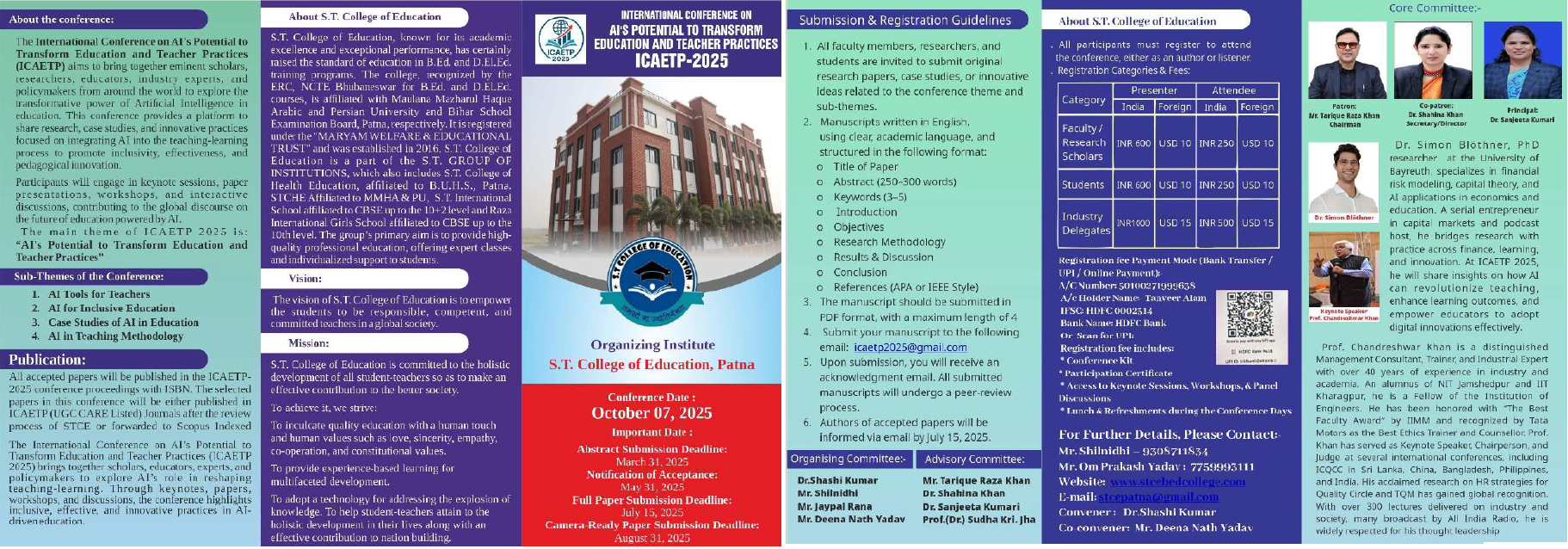
The International Conference on AI’s Potential to Transform Education and Teacher Practices (ICAETP) aims to bring together eminent scholars, researchers, educators, industry experts, and policymakers from around the world to explore the transformative power of Artificial Intelligence in education. This conference provides a platform to share research, case studies, and innovative practices focused on integrating AI into the teaching-learning process to promote inclusivity, effectiveness, and pedagogical innovation.
Participants will engage in keynote sessions, paper presentations, workshops, and interactive discussions, contributing to the global discourse on the future of education powered by AI.
The main theme of ICAETP 2025 is: “AI’s Potential to Transform Education and Teacher Practices”

Organizer

S.T. College of Education, known for its academic excellence and exceptional performance, has certainly raised the standard of education in B.Ed. and D.El.Ed. training programs. The college, recognized by the ERC, NCTE Bhubaneswar for B.Ed. and D.El.Ed. courses, is affiliated with Maulana Mazharul Haque Arabic and Persian University and Bihar School Examination Board, Patna, respectively. It is registered under the “MARYAM WELFARE & EDUCATIONAL TRUST” and was established in 2016. S.T. College of Education is a part of the S.T. GROUP OF INSTITUTIONS, which also includes S.T. College of Health Education, affiliated to B.U.H.S., Patna. S.T. International School affiliated to CBSE up to the 10+2 level and Raza International Girls School affiliated to CBSE up to the 10th level. The group’s primary aim is to provide high-quality professional education, offering expert classes and individualized support to students.

Important Dates:

Conference Date: October 7, 2025
Abstract Submission Deadline: March 31, 2025
Notification of Acceptance: May 31, 2025
Full Paper Submission Deadline: July 15, 2025
Camera-Ready Paper Submission Deadline: August 31, 2025

Paper Submission

  • The manuscript should be submitted in PDF format, with a maximum length of 4 pages.
  • Submit your manuscript to the following email: icaetp2025@gmail.com
  • Upon submission, you will receive an acknowledgment email. All submitted manuscripts will undergo a peer-review process.

Conference Contact Details:
Mr. Shilnidhi – 9308711834
Mr. Om Prakash Yadav : 7759993111

Website: www.stcebedcollege.com
E-mail: stcepatna@gmail.com
Convener : Dr.Shashi Kumar
Co-convener: Mr. Deena Nath Yadav

Published by:
× How can I help you?